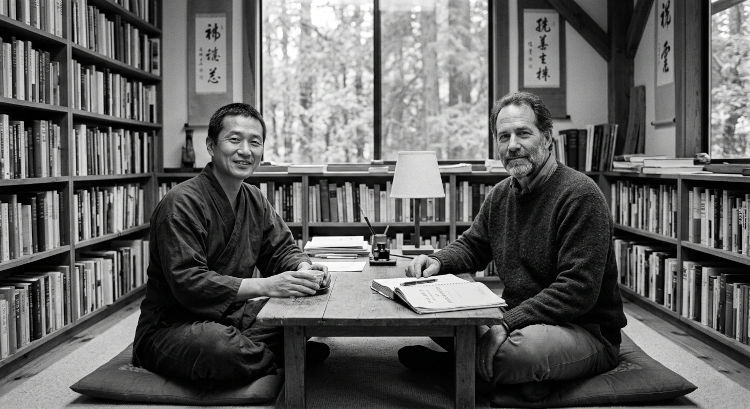
Jack Horowitz was a figure of significant influence in the early Silicon Valley landscape, an American businessman and philanthropist who transformed a windfall from the 1995 sale of his software company, Enclatech, to Microsoft into a spiritual inquiry into how humans interact with technology. Following the acquisition, Horowitz departed the United States for an extended five-year monastic sabbatical, seeking to reconcile his background in high-speed digital architecture with the ancient requirements of the human psyche. He settled first in McLeod Ganj, India, where he studied under the Venerable Tenzin Phuntsok and committed to a rigorous two-year vow of silence, a period he later described as essential for “defragmenting the internal hard drive.” He subsequently moved to Kyoto, Japan, immersing himself in the Rinzai school of Zen Buddhism. When Horowitz returned to the San Francisco Bay Area in 2000, he partnered with Hiroto Matsubara, a former systems engineer, to establish a spiritual community dedicated to mindfulness and the intentional, rather than reactive, use of technology.
This community eventually developed a formal philosophy and set of liturgical practices that local observers termed “Asynchronism.” While the community accepted this moniker, their official legal name is “The Foundation for Mindful Electronic Interaction,” abbreviated as FoMEI and pronounced “fo-may.” Horowitz and Matsubara posited that the escalating speed of human-information interfacing was fundamentally incompatible with mindfulness, leading to a state of permanent cognitive fragmentation. To protect their way of life, they sought and, in 2009, received federal recognition as a non-profit religious organization with 501(c)(3) status. This legal designation was a strategic turning point, as it afforded Asynchronist members protection under the Religious Freedom Restoration Act and Title VII of the Civil Rights Act of 1964. These laws required employers to provide reasonable accommodations for religious observances, which for Asynchronists meant a strict rejection of real-time digital communication tools such as instant messaging, persistent chat rooms, unscheduled telephony and video conferencing. They also observe a Saturday sabbath of spiritual reflection where they refrain from work and various activities involving all electrical devices. Their doctrine did not shun technology entirely but rather filtered it through the “Sacrament of Delay,” permitting the use of intentionally designed email, physical letters, and scheduled in-person meetings, all of which were viewed as “high-intent” forms of connection.
To facilitate these observances, the Asynchronist community has engineered a variety of open source tools designed to enforce latency in a digital landscape built for compulsive interaction. Their flagship project, KansoMail, is a modified mail transfer agent that uses machine learning to analyze, filter and cryptographically lock certain types of incoming messages, rendering them unreadable until a pre-set duration—typically four to twelve hours. This ensures that neither the sender nor the recipient can succumb to the pressure of immediate reciprocity. For collaborative work, they developed Coda, a platform that lacks a “refresh” button or live notifications. Recent iterations utilize machine learning that compiles all team contributions into a singular daily digest delivered at a fixed hour. For some Asynchronist companies, even their internal networking protocols are distinctive; the community maintains a specialized router firmware known as Gensen, which throttles bandwidth for any unauthorized UDP streams, effectively breaking the functionality of modern VoIP and video calling software.
Asynchronists are deeply intentional about how they work and the devices they use. Many don’t carry phones, or opt for “dumb phones” that have limited features. They shun laptops in favor of moleskins. In the Asynchronist workspace, the Japanese principle of Kanso is manifested through the intentional removal of all non-essential hardware, leaving only a single, high-quality display, a mechanical keyboard, paper and pen to eliminate any sensory clutter that might fragment deep concentration. To honor Shitsurae within their physical filing systems, some Asynchronists treat the storage of information as a deliberate “setting of the stage,” housing each document in hand-stitched linen folders and arranging them within wooden cabinets. This intentional curation transforms a mundane archive into a sacred space, where the act of retrieving a record is a slow, meditative ritual rather than a frantic search. Companies that embrace and accommodate them designate meditation rooms and sequestered workspaces that are free from the noise and visual distractions of the inexplicable open floor plan trend.
The movement has seen a steady rise in membership throughout the Silicon Valley region since the mid-2010s, attracting engineers, analysts and designers who were increasingly disillusioned by the “always-on” culture of the smartphone and social media era. While critics initially dismissed the movement as a clever “cultural hack” designed to avoid work, the reality proved more complex. During the annual fourteen-day sabbatical known as the Great Disconnection, members are required to abstain from all electronic communication, retreating into natural spaces for fasting and meditation. During these periods, reading and writing are permitted only via analog means between sundown and sunrise. Rather than hindering their careers, these practices began to produce a cohort of workers with unparalleled cognitive stamina and ethical integrity. Several major software firms, after initial legal skirmishes over the refusal of Asynchronists to use instant messaging platforms and participate in excessive meeting cultures, began to proactively recruit and accommodate them. These companies realized that by protecting their employees from the “distraction tax” of modern office life, they were gaining access to thinkers capable of the kind of profound, uninterrupted focus that was becoming increasingly rare.
The success of the Asynchronists is often cited as an influence on the broader “Deep Work” movement. The core of their power lay in the physiological concept of “attention residue”; by refusing to switch tasks or respond to immediate pings, Asynchronists avoided the cognitive drain associated with rapid context-switching. This allowed them to reach and maintain “flow states”, whereas the average knowledge worker was often interrupted every eleven minutes. The movement argued that the human brain requires significant “load time” to process complex problems, and that the modern demand for instantaneity was effectively lobotomizing the workforce. By codifying the need for silence and delay as a religious right, Horowitz and Matsubara created a sanctuary for the high-level cognitive processing that built the very infrastructure of the modern world. Today, the legacy of Asynchronism persists in the corners of the most successful tech firms, where the most valuable problems are solved not in a chat window, but in the deliberate, slow-cadence intervals of focused thought.
We recently visited the founders at the Asynchronist Sanctuary, a sprawling, understated complex of cedar and glass tucked into the fog-shrouded ridges of the Santa Cruz Mountains. To reach it, one had to navigate a series of winding fire roads, eventually arriving at a gate where a simple wooden sign requested that all mobile devices be surrendered to a lead-lined copper box. Walking into the central atrium, the air smelled of sandalwood and high-quality bond paper. Jack Horowitz and Hiroto Matsubara were waiting in a sunlit library, seated on floor cushions surrounded by thousands of physical volumes. Despite the immense pressure of the numerous labor lawsuits then facing the movement, both men appeared remarkably vital; Horowitz, then in his early fifties, possessed the clear-eyed, sun-browned composure of a long-distance hiker, while Matsubara exuded a joyful alertness, his movements precise and unhurried. They looked less like embattled cult leaders and more like men who had discovered a secret rhythm to time itself.
Interviewer: You’ve been called everything from Luddite revolutionaries to the world’s most expensive HR headache. Why go through the federal courts just to turn off your phones?
Jack Horowitz: It’s a common misconception that we hate the technology. I spent twenty years building it; I know its beauty. But we realized that the “ping” is not a neutral sound. It is an evolutionary predator. It triggers a cortisol spike that our ancestors reserved for rustling in the tall grass. When you live in a state of constant, forced interruptions, you aren’t living; you’re just reacting. We needed the 501(c)(3) status because, in America, the only thing more sacred than a quarterly profit is a religious conviction. We had to build a cathedral of time to allow people to think deeply.
Interviewer: Your acceptance process is famously grueling. You’ve turned away high-level executives who were willing to donate millions. Why the strictness?
Hiroto Matsubara: Because silence is a muscle that has atrophied in the modern world. People come to us thinking Asynchronism is a productivity hack—a way to get more done so they can buy more things, achieve a promotion or signify status. We reject them because they are still addicted to the result. That is incompatible with our ethos. To join the order, you must attend the weekly Ceremonies. These are three-hour sessions of communal silence where we sit. It is uncomfortable. It is boring. But if you cannot handle three hours of your own mind without a notification to validate your existence, you cannot be trusted with the deep, ethical work our society requires. We are not a club; we are a disciplined monastic order for the information age.
Interviewer: You talk a lot about the “ethics of attention.” What does that mean for the average person who isn’t living in a mountain sanctuary?
Jack Horowitz: It means realizing that your attention is the only thing you truly own. When you give it away for free to a flashing light on a dashboard, you are participating in your own colonization. We believe that the most pressing problems of our era—climate change, systemic inequality, the foundations of AI—cannot be solved in a 280-character window. They require a “long-wave” consciousness. We joke that we are the only people in the Valley who still know how to use a semicolon, but there is a deeper truth there. The decline of the complex sentence is the decline of complex thought.
Interviewer: There’s a rumor that some of the largest companies are now subsidizing “Async” wings in their headquarters. Is that a victory or a co-option?
Hiroto Matsubara: (Laughing softly) It is a surrender. They realized their best knowledge workers were burning out and producing “hollow” low quality work. They saw that our adherents were solving high level problems in four days what their distracted teams couldn’t solve in four months. We don’t mind the subsidization. If we can smuggle a few hours of deep, intentional peace into the heart of the machine, then the movement is succeeding. We aren’t trying to destroy the digital world; we are trying to give it a heartbeat again.
Interviewer: There is a growing secular movement around the concept of “Deep Work”—people adopting your methods but without the religious framework. Do you see that as a dilution of what you’ve built here?
Jack Horowitz: Not at all. We find it deeply encouraging. You have to understand that in any culture, change requires a pole—an extreme position that shifts the entire center of gravity. By being the “crazy” people who took a vow of silence and sued for the right to ignore a message, we moved the Overton Window. We made it socially acceptable for a secular knowledge worker to suggest that maybe, just maybe, they shouldn’t be in meetings for six hours a day. We are the lightning rod so that they can have the shade.
Hiroto Matsubara: (Nodding) There is a profound power in the mere existence of a valid alternative. When the status quo feels like a prison, even a distant lighthouse is a form of hope. We don’t mind the ridicule from the tech press; in fact, we welcome it. Ridicule is often the first stage of realization. When people laugh at us for using parchment and pens, they are actually acknowledging that a life without a smartphone is possible. They are looking for a way out of the frantic, dopamine-depleted cycle they’ve been sold. Our existence proves that the exit door isn’t locked.
Interviewer: So, you’re saying the “Deep Work” crowd is just the beginning of a larger exodus?
Jack Horowitz: The human spirit can only be compressed for so long before it pushes back. People are exhausted. They are tired of being “synchronized” with machines and disconnected from themselves. Whether they call it a religious observance or a productivity strategy, they are all reaching for the same thing: the right to be present in their own lives. We just provided the legal and spiritual architecture to make that choice defensible. Even if they never step foot in this sanctuary, the fact that we are here, sitting in the silence, changes the landscape. It reminds them that they aren’t just cogs in a real-time data stream. They are thinkers. And thinking, real thinking, takes all the time in the world.
The interview ended as the sun began to dip toward the Pacific, casting long, slow shadows across the library floor. Horowitz and Matsubara stood, their movements fluid and seemingly unburdened by the temporal urgency that defines the valley below. As they walked the interviewer to the gate, they didn’t check watches or glance at empty pockets where phones used to live. They simply stood in the cool mountain air, perfectly content to wait for the next moment to arrive on its own schedule.
The foundational document governing entry into the order, titled the Syllabus of Observances, was first codified in early 2004 and remains a remarkably austere text that outlines the transition from a reactive to an intentional existence. For the first six months, a prospective member, or Postulant, is required to undergo the Purgation of Immediate Response, which involves a total cessation of all real-time digital interaction during daylight hours and mandatory attendance at the twice-weekly Ceremonies. These ceremonies are held in the Sanctuary’s lower chambers, where participants sit in communal silence for three hours at a time, specifically trained to observe the physical itch of the phantom notification without acting upon it. The Syllabus describes this not as a meditative retreat, but as a re-wiring of the neural pathways necessary to reclaim the sovereign self from the predatory algorithms of the attention economy.
Following this initial phase, the Postulant enters the Period of the Sacrament of Delay, during which they must adhere to a strict seventy-two-hour latency period for all non-urgent communications. This stage is designed to cultivate high-intent connection, forcing the individual to weigh the necessity and ethical weight of every word before it is committed to either email or paper. During this time, the use of the Nocturnal Commonplace becomes mandatory; this is the practice of analog journaling and philosophical reading performed only between sundown and sunrise, using physical media to ensure that the mind is not subjected to the blue-light stimulation of the digital interface during its most reflective hours. The Syllabus notes that the goal of this ritual is the development of a long-wave consciousness, allowing the individual to perceive patterns and structural truths that are invisible to those trapped in the high-frequency noise of the modern world.
The final stage of the Syllabus is the most grueling, culminating in the Great Disconnection, a thirty-day silent retreat in the high wilderness where the candidate must live entirely without electronic devices or mechanical timekeeping. This period is overseen by established members of the order who monitor the candidate’s ability to maintain the Litany of the Single Task, a practice of focusing on a single complex problem for six to eight hours without interruption. Only after completing this cognitive marathon and passing a peer review is the individual granted full status within the movement. The Syllabus concludes with a solemn reminder that Asynchronism is not a refuge for the lazy, but a fortress for the focused, asserting that in an era of infinite distraction, the most radical act of rebellion is to simply finish a thought. This rigorous framework is what allowed the Asynchronists to maintain their integrity even as their methods were co-opted by the secular corporate world, ensuring that the movement remained a true monastic order rather than a mere lifestyle trend.
This is a work of satirical fiction. AI was used for grammatical review. Cover image generated by Gemini Nano Banana.