
We don’t have a problem, we just need a plan.
— Timothy Leary
The U.S. inflation data came in higher than expected last week. That, of course, means we’re facing continued erosion of purchasing power and higher interest rates. In real terms, one hundred dollars from 2019 is now worth less than seventy. That’s tough for Americans who are uncertain about Social Security solvency and saving for retirement.
Lately, I’ve been trying to unpack the nuances of interest rate policies in high-debt-to-GDP scenarios and thought I’d share some evolving thoughts, questions, and ideas. The key challenges have been understanding the problem well enough to evaluate it while avoiding the common trap that seems to plague economics writ large: the assumption that this is how it must work.
Viewed through the lens of complex systems theory, economics seems constrained by orthodoxy because academic institutions and professional networks function as positive feedback loops. Real-world economies operate as nonlinear, adaptive networks characterized by emergence and path dependence. Popular macroeconomic thinking is a powerful shared narrative that societies tell themselves to legitimize policy and power. When everyone from central bankers to textbook authors agrees to treat the economy as if it were governed by natural laws, it’s easy to forget that we made it up and can thus also change it.


Before we dive in, let’s clear one thing up: the inflation we’ve been experiencing, beyond the obvious pandemic spending hangover, is supply-side. It doesn’t take a PhD in economics to see how ongoing disruptions in the global oil supply are the primary driver. It’s easy to get lost in technical details, but when oil prices rise, inflation rises, yields rise, interest rates rise, and it becomes a feedback loop that’s hard to stop—and easy to misattribute blame. Raising interest rates doesn’t lower oil prices. Absent the oil shocks, inflation would likely be closer to the Federal Reserve’s 2% target. That’s precisely why I’ve been trying to tease apart a couple of seemingly simple questions:
- First, how do we know that raising interest rates mitigates inflation in a high-debt-to-GDP environment?
- Second, and more broadly, if a high-debt-to-GDP regime is the operational reality for the entire global economy post-COVID, why are we clinging to 20th-century debt management strategies in a post-globalized world facing entirely different climate, energy, and demographic challenges?
At this point, we need to zoom out from the problem and think much bigger than whether central banks will tinker with interest rates. Our dilemma underscores a deeper structural issue: the U.S. political system’s inability to align reasonable, long-term economic policies with the short-term incentives of election cycles. Without the discipline to manage debt sustainably or the foresight to implement countercyclical policies before crises strike, policymakers are left with increasingly limited and blunt instruments as their only tools for averting economic collapse. The result is a cycle of reactive policymaking that fails to address the root causes of instability.
But why? One reason is the “too big to fail” problem we faced nearly twenty years ago. The financial industry’s share of U.S. GDP has more than doubled since the 1950s, prioritizing shareholder value, short-term profits, and speculative investments over long-term growth and stability. The financial sector—including banks, investment firms, insurance companies, and real estate—has consistently been one of the top contributors to U.S. political campaigns. Key drivers include deregulation (e.g., the repeal of Glass-Steagall), the rise of institutional investors, and complex financial instruments. Corporate behavior has demonstrably shifted toward financial engineering, such as stock buybacks, while household wealth increasingly relies on financial assets, exacerbating inequality.
Repeating the same thing and expecting different results is the definition of insanity. Assuming the U.S. political apparatus is incapable of deficit reduction, we’ll be left with the Treasury and Federal Reserve to clean up the next mess—again. That’s obviously not working for the majority. So let’s consider some unorthodox policy alternatives and how they might play out.
Try Looking at It Downside Up
Like an addict, we must first accept that we have a problem: the dynamics of interest rates fundamentally change in a high-debt-to-GDP regime. Long-duration debt creates a channel of stimulus for people and entities that don’t need it—and worse, rising yields pose a real vulnerability to a sovereign nation’s ability to manage expenditures. The Treasury’s primary auction of long-duration debt must clear the market at the mercy of prevailing rates. Issuing long-duration debt during a high-rate regime forces the government to lock in elevated coupon payments for decades, driving net interest expenditures significantly higher as a percentage of GDP. This escalation crowds out private capital investment by absorbing available market savings and pushes term premiums upward as investors demand higher compensation for holding long-term duration risk.
A 2026 paper by Huixin Bi, Maxime Phillot, and Sarah Zubairy notes that when the government reduces long-term debt issuance, it relieves upward pressure on long-term yields, lowering private borrowing costs and stimulating capital investment, construction, and economic activity. Conversely, heavy long-duration issuance in high debt-to-GDP environments raises long-term borrowing costs and restricts private sector financing. Laura Alfaro and Fabio Kanczuk find in their research that long-term debt is not necessarily optimal for sovereign borrowers, demonstrating through quantitative models that short-term debt can lower average borrowing costs and reduce default frequencies by avoiding the high risk premiums and structural rigidity tied to long-duration bonds. The default risk and crowding out effect more than offsets the administrative burden of rolling over short term debt.
My understanding of this dynamic was deepened by looking back at a brief period when we had the opposite problem — during the budget surpluses of the Clinton administration. You’d think the root cause of our troubles would be solved by paying off the debt, like a household. It instead revealed different systemic problems. During the late 1990s and early 2000s, consecutive federal budget surpluses sparked projections that the entire publicly held U.S. national debt would be paid off within a decade, eliminating the need for the Treasury to sell notes and bonds. Ironically, this alarmed central bankers because the Federal Reserve’s traditional monetary policy framework since World War II relied entirely on buying and selling liquid U.S. Treasury securities to inject or drain reserves and control the federal funds rate.
What alarmed them even more was that abandoning long-term government bonds would remove the primary duration-risk-free asset that global pension funds, insurance companies, and foreign central banks rely on for institutional savings and regulatory compliance. While that scenario didn’t fully materialize, the mere prospect of a scarcity of risk-free, long-duration government assets in the 2000s created a massive vacuum in global institutional portfolios. Thanks to deregulation, Wall Street was more than happy to engineer private alternatives to replicate duration and yield, turning a profit in the process. Investment banks loaded up their balance sheets with conforming and subprime mortgages, securitizing them into structured products marketed as safe, high-yielding equivalents to sovereign debt. Rating agencies awarded AAA ratings to the senior tranches of these CDOs under the flawed assumption that geographical diversification and housing market appreciation eliminated systemic default risk. Institutional capital flooded into these private-label instruments because no government alternative existed to satisfy long-term liability-matching requirements.
We all know what happened next—and hopefully, we can picture the Jenga tower in The Big Short. Nothing has been the same since. We didn’t address the root cause of the problem.
Obviously, we started borrowing again by 2001, and shifted the burden of safe instrumentation back to the government. However, in the high debt-to-GDP regime of 2026, relying on long-term government securities to meet the liability-driven investment needs of institutional investors creates significant market vulnerabilities for the sovereign. By locking in long-term government bonds, the duration premium borne by taxpayers increases, and interest rate risk rises sharply. Additionally, the long end of the yield curve becomes intolerably volatile and subject to refinancing frictions during periods of fiscal expansion.
Do We Have The Right Tools?
To mitigate these systemic burdens, heterodox monetary policy proposals suggest shifting Treasury issuance toward short-term Treasury bills or leveraging central bank term deposit facilities or reserve mechanisms. In practice, such measures have been repeatedly adopted during crises. So why not institutionalize them permanently? This approach would eliminate costly duration premia, shield the federal budget from long-term interest rate shocks, and align monetary policy more closely with short-term rate targets.
Routine issuance of interest-bearing government debt stems from the gold standard era, where it served to attract capital and maintain gold convertibility. Though the U.S. abandoned the gold standard in 1933 and 1971, the practice persists as a vestigial policy habit. Today, debt issuance primarily functions as a tool for interest rate targeting by swapping excess reserves for bonds to prevent rates from falling to zero. Central banks could control interest rates more directly by paying interest on bank reserves instead of relying on government bond sales. When governments spend, they add reserves to the banking system, which would normally push rates down. Rather than draining those reserves by issuing bonds, the central bank could simply adjust the interest rate it pays on reserves—raising it to increase rates or lowering it to cut borrowing costs. This would make bond issuance unnecessary for rate control, creating a more efficient system.
However, eliminating long-term safe assets would revive the aforementioned duration-matching challenges faced by pension funds and insurance companies. History shows that the private sector lacks the appropriate incentives to solve this problem without introducing structural risk. The optimal solution may lie in sovereign wealth funds (SWFs) and transparent public special purpose vehicles (SPVs) that issue bonds backed not by speculative private securitizations like mortgage-backed securities or collateralized debt obligations (CDOs), but by productive, cash-flow-generating national infrastructure and diversified international assets.
The key distinction is that only the state can create a robust alternative national fund capable of mobilizing private capital at tremendous scale into high-return productive investments.
A practical implementation strategy in the U.S. could unfold in three phases:
- The Treasury fully transitions its debt issuance to short-term T-Bills.
- A newly established sovereign wealth fund, capitalized through an initial asset transfer, issues long-term bonds backed by infrastructure.
- Public special purpose vehicles are created to directly finance energy, welfare, strategic industries and transportation networks.
The primary benefits of this framework include:
- Lower debt service costs for taxpayers
- Elimination of yield curve volatility
- Provision of transparent long-term assets for institutional investors
- Greater resilience against shadow banking risks
Potential risks include:
- Rollover pressure from short-term debt dependence
- Political interference and misallocation within the sovereign fund
- Market frictions as capital markets adapt to public duration products
Rather than the Treasury issuing 30-year bonds to finance general deficit spending, the SWF would hold a diversified portfolio of domestic infrastructure, strategic equity stakes, and international assets. It would then issue long-term bonds backed by the cash flows and capital appreciation of this portfolio—managing long-term liabilities without direct recourse to taxation.
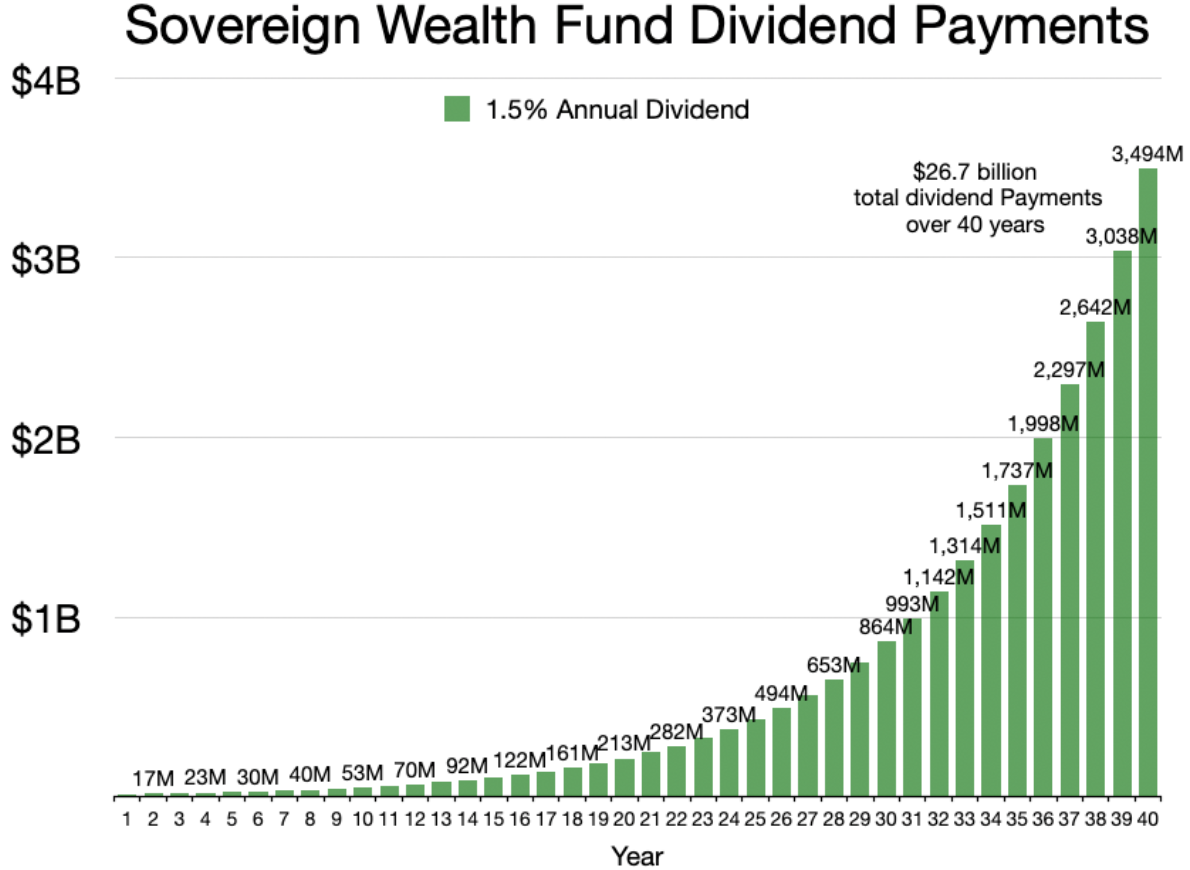
Unlike private structured finance products, the SWF’s balance sheet would be subject to public audits and standardized reporting, eliminating the information asymmetries that fueled the 2008 financial crisis.
Toll roads, power grids, power plants, water systems, and public transit generate predictable long-term cash flows. Moreover, portfolios may include equity and debt stakes in a wide range of strategic corporate interests like technology, biotech and defense. Public entities can issue long-term project bonds directly linked to these tangible assets. These instruments would feature standardized legal documentation, zero leverage, and direct public oversight—offering duration profiles comparable to long-term government bonds while avoiding increases in sovereign debt or reliance on opaque bank derivatives.
To address the structural deficits faced by pension funds and insurers—where promised payouts to retirees and policyholders exceed the returns available on safe long-term assets—the Federal Reserve could adapt its operational framework. It could offer fixed-rate term deposits or central bank-backed pension products directly on the balance sheets of these institutions, tailored to their liability profiles.
Borrowing Great Ideas
To assess the economic feasibility of replacing long-term sovereign debt with short-term financial instruments, it is essential to examine how sovereign wealth funds (SWFs) or public special purpose vehicles (SPVs) have been used to meet institutional investor demand for long-term safe assets. Several countries have successfully absorbed long-term capital by leveraging public balance sheet mechanisms without over-relying on private securitization or traditional long-term sovereign bonds.
For example, Australia’s Future Fund, established in 2006, manages assets specifically designated to cover long-term government pension (superannuation) liabilities. Rather than issuing long-term sovereign bonds, the Australian government transferred large initial capital injections and surplus revenues to a professionally managed public fund, which invests in a diversified global portfolio. This demonstrates that long-term liability matching can be decoupled from traditional sovereign bond issuance, allowing public institutions to accumulate duration assets without expanding traditional bond markets.


Similarly, Singapore employs a dual-entity model through its Government Investment Corporation (GIC) and Temasek. GIC manages foreign reserves with a focus on long-term real return objectives, investing globally in long-term assets, real estate, and infrastructure, while Temasek directly holds equity stakes in strategic state-owned enterprises such as transportation, energy, and communications. These entities generate predictable long-term cash flows and capital growth to support national development and intergenerational wealth accumulation without relying on complex private-label structured products.
France’s Caisse des Dépôts et Consignations (CDC), founded in 1816, serves as another model of long-term investment management. The CDC pools regulated savings deposits (e.g., Livret A) and pension reserves to fund long-term public infrastructure, social housing, and energy transition projects. It also issues government-guaranteed or asset-backed long-term bonds tailored to the duration profiles required by pension funds and insurers, providing necessary duration-safe assets without resorting to complex private derivatives like CDOs.
We don’t have a problem, we just need a plan. Rising long-term debt costs, the need for sustainable infrastructure investment, and the demand for safe, long-duration assets are not insurmountable problems. By thoughtfully integrating the proven strategies of sovereign wealth funds, public special purpose vehicles, and asset-backed long-term financing, the U.S. can modernize its fiscal architecture while maintaining economic stability and intergenerational equity. America can create a more flexible, transparent, and productive public balance sheet. This hybrid approach would not only reduce reliance on volatile short-term borrowing but also unlock long-term growth by channeling capital into critical national priorities, from clean energy to resilient infrastructure, all without sacrificing fiscal prudence or accountability. In doing so, the U.S. can turn structural economic challenges into opportunities for sustainable prosperity.