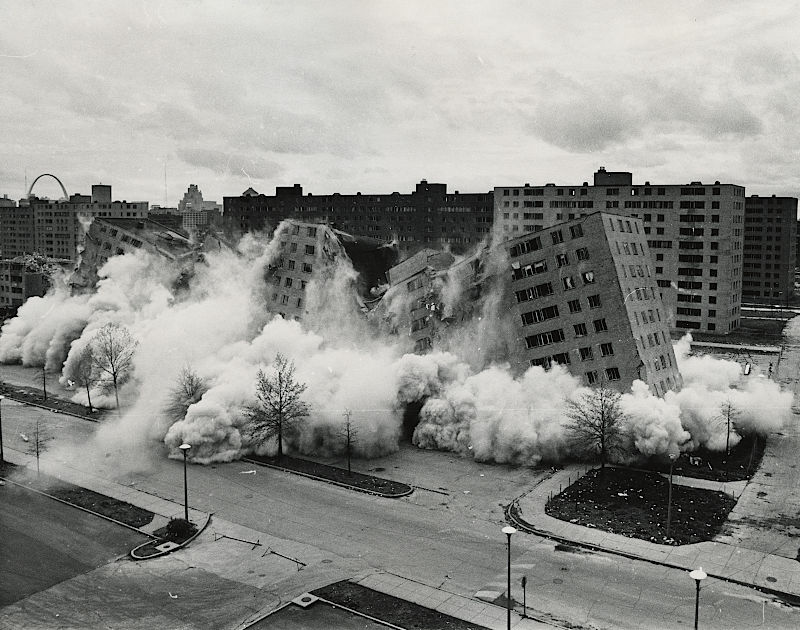
I was re-watching the classic 1982 documentary film Koyaanisqatsi recently and was struck by the dramatic aerial footage of the massive St. Louis housing project Pruitt–Igoe. A sprawling fifty-seven-acre site on the north side of St. Louis, Pruitt-Igoe consisted of thirty-three eleven story buildings. The sequence opens with wide static shots of the decaying modernist architecture, where nearly every large pane glass window that once protected family living rooms and bedrooms is shattered or missing. Then targeted explosive charges begin detonating inside structural columns of the massive concrete slab buildings. Smoke and dust engulf structures as exterior facades collapse inward, pancaking floors downward in slow motion synchronized with Philip Glass’s minimalist orchestral score. Footage captures the scale of destruction through dust clouds and structural skeletons remaining amidst rubble.
I was shocked to later learn that the buildings were only eighteen years old. In total, the housing project had cost over half a billion dollars when adjusted for inflation.
Like other large scale projects, Pruitt-Igoe began as a bold vision of post-war modernist public housing, designed by architect Minoru Yamasaki to replace the overcrowded and deteriorating slums of St. Louis. Completed in 1954 and named after World War II fighter pilot Wendell O. Pruitt and former Missouri Congressman William L. Igoe, the development consisted of thirty-three eleven-story slab buildings. It was intended to offer sanitary, light-filled apartments featuring innovative “skip-stop” elevators and communal gallery spaces meant to foster a vertical neighborhood community.
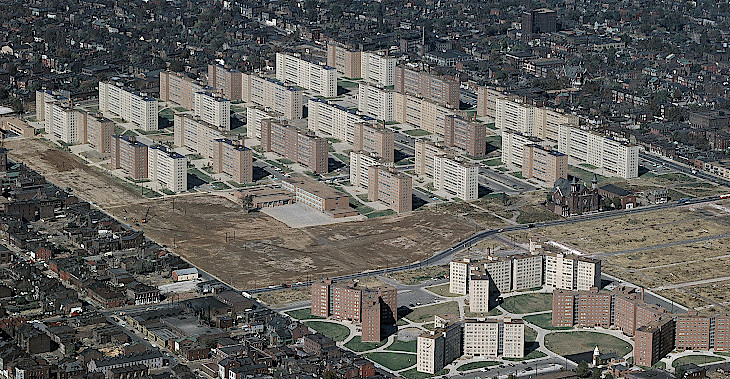
Despite its architectural pedigree and early praise, the complex deteriorated rapidly due to severe funding shortages and structural neglect. Maintenance budgets depended entirely on tenant rents, but as federal housing policies shifted and a massive exodus of middle-class residents to the suburbs left St. Louis with a shrinking tax base, rental revenues plummeted. Maintenance deferred on roofs, plumbing, and elevators turned the buildings into hazardous environments. Socioeconomic and ethnic segregation heavily concentrated impoverished residents within the complex while simultaneously depriving it of vital municipal services and police protection.
By the late 1960s, vacancy rates soared past sixty percent, and Pruitt-Igoe became synonymous with the rampant crime, vandalism, and infrastructural decay of large scale urban housing projects throughout the U.S. The federal and local authorities ultimately concluded that the complex could not be salvaged, leading to the dramatic demolition of the first building via explosives in July 1972. This event was broadcast nationally, transforming Pruitt-Igoe into a cultural and architectural symbol for the failure of large-scale modernist urban renewal and the systemic neglect of public housing. Nixon subsequently suspended all federal housing subsidy programs on January 5, 1973 which marked the end of an era.
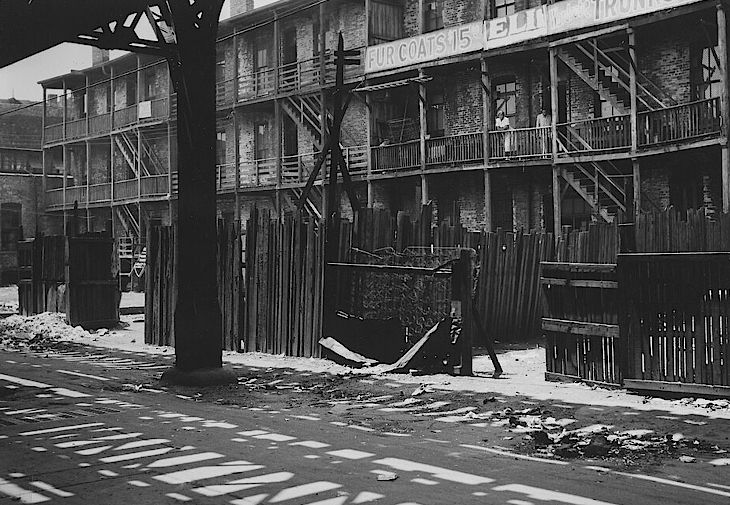
These grand structures were a failed attempt to fix a problem. During the 1920s to 1940s, the urban slums of large cities like St. Louis, Chicago, and New York were densely populated, impoverished neighborhoods marked by overcrowding, inadequate housing, and poor sanitation. In St. Louis, areas like the Ville and DeSoto-Carr were plagued by substandard tenement buildings, where families shared cramped, poorly ventilated apartments with limited access to clean water and sewage systems. Chicago’s slums were characterized by dilapidated wooden frame houses and overburdened infrastructure, exacerbated by thousands seeking industrial jobs and relegated to segregated, under-resourced neighborhoods. New York’s slums were notorious for their tenement housing, where people lived in squalid conditions, with fire hazards, lack of heat, and rampant disease. These neighborhoods were also hotbeds of social unrest, with high crime rates, labor exploitation, and systemic neglect by municipal governments, yet they also fostered vibrant cultural communities, particularly in music, literature, and activism, as residents navigated the harsh realities of urban poverty.
By the mid-20th century, American cities sought to solve these problems with large-scale public housing projects—towering, monolithic developments designed to alleviate poverty and segregation. Yet these efforts, often well-intentioned, frequently deepened the very problems they sought to solve. Few understood this contradiction as clearly as Robert Taylor, an architect and urban planner whose vision for public housing was decades ahead of its time. Born in Tuskegee, Alabama, in 1899, Taylor grew up in an environment steeped in architecture and social reform. His father was the first black man in the U.S. to earn a formal architecture degree and taught at Tuskegee University for decades. After studying architecture at Howard University and business administration at the University of Illinois, Taylor moved to Chicago, where he managed the Michigan Boulevard Garden Apartments—an early experiment in housing designed specifically for black families. His work in real estate and urban planning led to his appointment in 1938 as the first black commissioner of the newly formed Chicago Housing Authority. By 1941, he had risen to chairman.
Taylor’s tenure at the CHA was marked by a radical vision for public housing: one that prioritized integration and small-scale, dispersed development. He argued that confining low-income families to isolated, segregated areas would drain resources from neighborhoods and entrench cycles of poverty. Instead, he advocated for low-rise housing developments scattered across diverse parts of the city, ensuring that residents could access existing transit, jobs, and services without overburdening any single community. His approach was rooted in a belief that housing policy could either reinforce segregation or help dismantle it.
Taylor’s ideals, however, collided with the entrenched politics of post-war Chicago. Aldermen and neighborhood groups vehemently opposed public housing in their wards, using their political influence to block potential sites. The result was a system that funneled families into a handful of high-density, segregated developments—precisely the outcome Taylor had warned against. Frustrated by years of obstruction and unable to implement his vision, he resigned in 1950.
The irony of Taylor’s legacy became fully apparent in 1962, when Chicago opened the Robert Taylor Homes. Named in his honor, the development consisted of 28 identical 16-story towers stretching nearly two miles along the South Side. Though intended as a tribute to his decades of public service, the complex embodied the very problems Taylor had spent his career trying to prevent: concentrated poverty, racial isolation, and the erosion of community resources. By the late 20th century, the Robert Taylor Homes had become a symbol of public housing’s failures—a textbook case of how large-scale, segregated developments could deepen, rather than alleviate, urban inequality. It was demolished in the early 2000s, a belated acknowledgment of the flaws in the policies Taylor had resisted.
These projects were undermined by a confluence of factors: shifting economic priorities that redirected funding toward highways and suburban sprawl, political compromises that prioritized cost-cutting over livability, and entrenched zoning laws that confined public housing to marginalized neighborhoods. NIMBYism (“Not In My Backyard”) fueled opposition to integrated housing, while “compromises” in site selection and tenant assignment policies devolved into a tool of systemic containment, reinforcing racial and class divides rather than alleviating them. It left behind a legacy of disinvestment and segregation that continues to shape American cities today.
The story of affordable housing in the U.S. has always been complex, involving a patchwork of competing priorities, reflecting broader tensions between equity, market forces, and political expediency. From the New Deal’s early public housing experiments to the post-war suburban boom fueled by redlining and FHA-backed mortgages, federal policy has oscillated between bold interventions and deliberate exclusion. Later efforts, like the Section 8 voucher program or tax incentives for low-income housing, sought to decentralize solutions but often reproduced inequality through underfunding, bureaucratic hurdles, or reliance on private markets ill-suited to serve the most vulnerable. Today, debates over zoning reform, inclusionary zoning, and community land trusts continue to reveal deep divisions over whether housing is a public good or a commodity. This fragmented history underscores how solutions, no matter how well-intentioned, are frequently constrained by structural inequities, fiscal shortfalls, and the enduring legacy of economic segregation.
The Old Deal
In the grand mythology of American progress, few narratives are as seductive—or as misleading—as the idea that the mid-20th century was a golden age of social democracy. The New Deal and Great Society eras are often held up as proof that capitalism, when tempered by enlightened policy, could be made to serve the many rather than the few. And indeed, for a brief, shining moment, it seemed possible. The federal government built public housing. It guaranteed mortgages. It subsidized homeownership. It even, in the case of the GI Bill, handed out one of the most massive wealth transfers in history—to the very people who had just spent years fighting a world war.
But golden ages are always, by definition, fleeting. The New Deal and Great Society housing programs were born in crisis, nurtured in hope, and then systematically dismantled by the very forces they were meant to resist. The story of their rise and fall is a parable about power, about who gets to decide what a home is for, and about the ways that capitalism reasserts its dominion over the spaces we live in.
When Franklin Delano Roosevelt took office in 1933, America was in the grip of the Great Depression, and the housing market was in shambles. Foreclosures were rampant. Slums festered. Banks had collapsed, taking people’s life savings with them. The federal government’s response was, by today’s standards, almost unthinkable: it built housing. Not just any housing—decent housing. The Public Works Administration (PWA) and later the Works Progress Administration (WPA) constructed tens of thousands of units, many of them architecturally ambitious, designed to foster community rather than profit. The Housing Act of 1937 created the U.S. Housing Authority, which provided long-term, low-interest loans to local public housing agencies. By 1940, over 100,000 units had been built.
But the New Deal’s housing programs were never just about shelter. They were about redistribution—about using the power of the state to break the stranglehold that real estate interests, banks, and landlords had over ordinary people’s lives. The Home Owners’ Loan Corporation (HOLC) refinanced millions of mortgages, preventing foreclosures. The Federal Housing Administration (FHA) made homeownership accessible to millions who had been locked out of the market by redlining and discriminatory lending practices.
And yet, even in its most radical moments, the New Deal was constrained by the contradictions of American capitalism. Public housing was never meant to be permanent. It was a stopgap, a way to stabilize a collapsing system. The FHA’s mortgage guarantees were a subsidy to private lenders, reinforcing the very institutions that had helped create the crisis in the first place.
By the time Lyndon B. Johnson took office in 1963, the New Deal’s housing programs were already in retreat. The FHA had become a tool for suburban expansion, its loans flowing overwhelmingly to white, middle-class families while redlining and covenants kept minority families trapped in decaying urban cores. Public housing, meanwhile, had become a symbol of failure—a last resort for the poorest of the poor, warehousing people in high-rise ghettos rather than integrating them into thriving communities.
Johnson’s Great Society sought to correct this injustice. The Housing and Urban Development Act of 1965 created the Department of Housing and Urban Development (HUD) and expanded funding for public housing. The Model Cities Program aimed to revitalize urban neighborhoods by investing in infrastructure, education, and economic development. The Fair Housing Act of 1968 outlawed discrimination in housing, a belated but necessary step toward undoing the legacy of redlining.
For a moment, it seemed like the tide might turn. But the Great Society, like the New Deal before it, was born in a moment of crisis—and crisis, as we know, is fleeting. The Vietnam War drained resources. The urban rebellions of the late 1960s fueled a backlash among white suburbanites who saw public housing and anti-poverty programs as threats to their property values. And the real estate industry, sensing weakness, began to push back.
The death of the New Deal/Great Society housing vision was a slow, creeping counterrevolution. It began with Nixon’s 1973 moratorium on public housing construction, a move justified by claims of fiscal responsibility but motivated by a desire to starve the beast of social housing. It continued under Reagan, who slashed HUD’s budget, gutted Section 8 housing vouchers, and championed “privatization”. By the time Clinton took office in 1993, the writing was on the wall: public housing was to be demolished, not expanded. The 1996 welfare reform act further eroded the safety net, leaving millions of low-income families with even fewer options.
The final nail in the coffin came in the form of the 2008 financial crisis. As banks collapsed under the weight of predatory lending and subprime mortgages, the federal government’s response was not to nationalize the housing market or expand public housing. Instead, it bailed out the banks, poured trillions into propping up the real estate industry, and left millions of families to face foreclosure. The Home Affordable Modification Program was a bureaucratic nightmare that helped almost no one. Meanwhile, private equity firms like Blackstone swooped in to buy up foreclosed properties, turning them into rental empires.
The Achilles Heel of the Great K
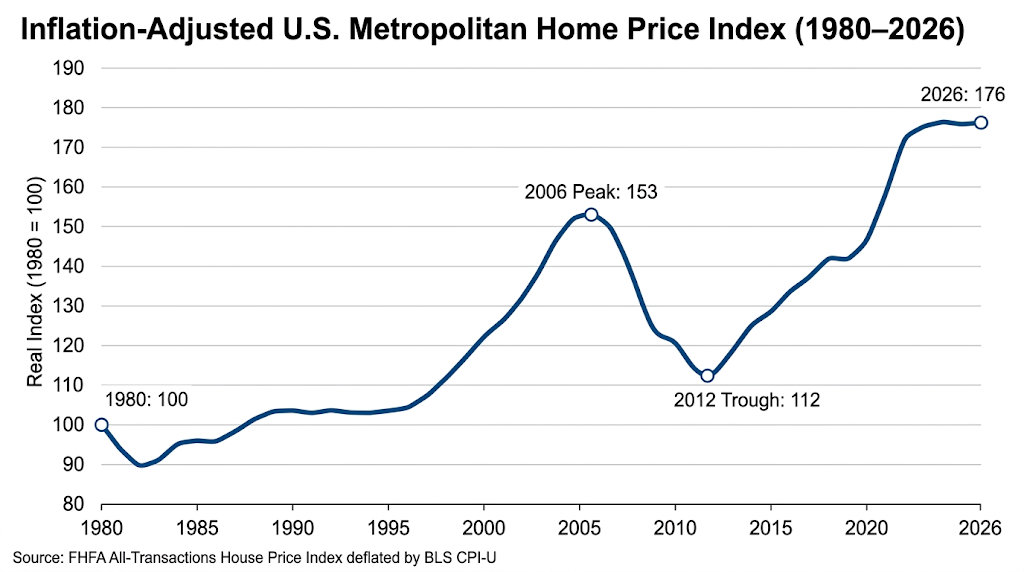
The great paradox of the modern American economy is that it is, by all conventional measures, booming. And yet, for many, it may feel like a slow-motion collapse. The stock market soars, corporate profits surge, and the top 10% of households now own a staggering 89% of all stocks. Meanwhile, wages for the bottom 50% have stagnated for half a century, and the inflation adjusted cost of housing in metropolitan areas has increased by 500% since 1980. This is the paradox of the K-shaped economy: the rich get richer, the poor get poorer, and the middle class is slowly hollowed out. If I had to identify a single systemic risk to the U.S. economy—our Achilles’ heel—it wouldn’t be the national debt, the stock market, the labor force, our dynamism to innovate, trade imbalances, deindustrialization, A.I. or the exchange rate. It would be housing.
When the rent goes up people consume less. The economy’s reliance on consumer spending, which now accounts for roughly 70% of GDP, particularly by the top 20% of earners and indebted lower-income groups, creates structural fragility, as economic growth becomes tied to unsustainable debt levels or volatile financial markets rather than broad-based prosperity. Historically, middle-class households with stable wages and rising incomes powered this consumption, but over the past few decades, the burden of spending has increasingly fallen on higher-income groups and lower-income households relying on debt, as stagnant wages for the majority and rising inequality have constrained purchasing power. Meanwhile, the financial sector’s expansion—facilitated by deregulation and easy credit—has encouraged households to leverage assets (like homes) or take on debt to sustain consumption, while corporate strategies now focus on marketing and consumer debt to drive sales rather than wage growth.
Nationally, nearly half of all U.S. renter households—approximately 22.7 million—are considered “cost-burdened,” meaning they spend more than 30% of their income on rent and utilities. Of these, 26% (12.1 million households) are “severely cost-burdened,” allocating over 50% of their income to housing. The burden has also extended into middle-income brackets, with roughly 72% of households earning between $30,000 and $44,999 facing cost burdens. Lower-income renters, particularly those earning under $30,000, face extreme vulnerability, as their remaining income for essentials like food, healthcare, and transportation has dwindled significantly.
Around 20-25% of high-income earners (households earning $100,000 or more annually) live paycheck to paycheck. Many high earners accumulate substantial debt through mortgages, car loans, or credit cards simply to keep up appearances. Expensive private schools, luxury housing, and premium services eat into earnings, while mortgages, car loans, and credit card debt add financial pressure. Even with six-figure incomes, poor budgeting or unexpected expenses can leave little savings, forcing families to rely on each paycheck.
What was once a joke on an SNL skit about “Living in a van down by the river,” is increasingly a lived reality for many Americans. Chloé Zhao’s 2020 drama, Nomadland vividly captures the harsh reality of older Americans priced out of housing, forced to live in cars and vans as they navigate a precarious existence on the margins of the economy. Based on Jessica Bruder’s nonfiction book, it follows Fern (Frances McDormand), a widow who abandons her sedentary life in Nevada to embrace van life, drifting through the American West in search of seasonal work. The film starkly contrasts the freedom of the open road with the grinding poverty and isolation of those who have no other choice, exposing the failures of a system that leaves the elderly vulnerable to exploitation and homelessness.

This isn’t fiction. Countless YouTube channels now feature older Americans chronicling their struggles, having spent lifetimes working only to spend their final years in remote RV parks or nomadic caravans, piecing together odd jobs to survive on meager Social Security checks. The number and share of older adults experiencing homelessness are rising, revealing a crisis that defies broader national trends. Adults aged 55 and older now make up nearly one-fifth of all people experiencing homelessness in the United States—a stark contrast to other groups, such as veterans, who have seen declines due to targeted federal interventions. Even as overall homelessness numbers fluctuate, the older adult demographic continues to grow in both raw numbers and proportion.
Housing is the invisible backbone of the K-shaped economy because it is, simultaneously, the most essential and the most precarious part of most people’s lives. For the wealthy, real estate is just another asset class. It’s something to be leveraged, flipped, or left vacant as a tax write-off. For the middle class, a home is now the single largest expense, a source of both security and sometimes suffocating debt. For the working poor, it’s a constant threat of eviction or homelessness lurking just behind the next paycheck. The housing market isn’t a symptom the K-shaped economy—it is the cause. The same forces that have hollowed out wages and concentrated wealth have turned housing into a speculative playground, where the rich extract value from the poor while the state looks the other way.
And that’s why it’s our Achilles heel. Because no matter how much wealth the top 1% accumulates, no matter how many luxury condos they buy in Miami or Manhattan, the economy still depends on people having somewhere to live. Workers can’t afford to live near their jobs, so they spend hours commuting, burning gas, and losing productivity. Families can’t save for emergencies, so one unexpected expense sends them into debt. Young people can’t move out of their parents’ basements, so they delay starting families, which means fewer future workers, which means slower economic growth. The K-shaped economy was built on the assumption that the bottom half will always find a way to pay—whether through debt, gig work, or sheer desperation. But housing is the one thing that can’t be endlessly squeezed. Sooner or later, the system breaks.
Solutions
Today, affordable housing reforms remain a complex web of interconnected challenges that often stall progress or lead to unintended consequences. Economic barriers remain one of the most persistent obstacles, as rising land costs, construction expenses, and labor shortages drive up development costs, making it difficult to build affordable units without substantial subsidies. Even when funding is available, political resistance frequently emerges, whether from NIMBY (“Not In My Backyard”) opposition to new housing projects or from fiscal conservatives wary of public spending. Zoning laws, which were historically used to exclude lower-income residents through restrictive density limits or single-family zoning, continue to perpetuate segregation and limit housing supply.
Beyond structural and political hurdles. Many affordable housing initiatives have historically been concentrated in disinvested neighborhoods, reinforcing cycles of poverty rather than breaking them. Meanwhile, gentrification pressures in growing cities can displace long-term residents even as new affordable units are built, displacing the very communities reforms aim to serve. Additionally, bureaucratic inefficiencies—such as slow approval processes, fragmented funding streams, and lack of coordination between agencies—can delay or derail projects. The result is a patchwork of solutions that often fall short of addressing the scale of need, leaving millions of households cost-burdened or homeless. These challenges underscore why housing reform requires not just financial investment but also systemic changes in policy, governance, and public perception.
One notable example of divergent approaches can be seen in Boston’s Columbia Point and Commonwealth projects. Columbia Point, developed in the 1950s, was a large-scale public housing initiative similar to Pruitt-Igoe. However, by the 1980s, it too had become emblematic of the failures of traditional public housing—marked by neglect, crime, and deteriorating conditions. In contrast, Commonwealth, a mixed-income development completed in the 1990s, represented a shift toward market-driven solutions and public-private partnerships. Unlike Columbia Point’s top-down public housing model, Commonwealth incorporated market-rate units alongside subsidized housing, aiming to integrate low-income families into a more stable, economically diverse community.
The contrasting fates of these two developments highlight the broader debate over housing policy: whether to prioritize government-led solutions (as in Columbia Point) or market-based approaches (as in Commonwealth). Columbia Point’s decline underscored the risks of underfunding and segregation in public housing, while Commonwealth’s mixed-income model reflected a growing belief in leveraging private investment to achieve affordable housing goals. These examples illustrate how housing reform can take different ideological and practical paths, with outcomes shaped by policy choices, funding mechanisms, and community engagement.
The Section 8 Housing Choice Voucher Program in the U.S. provided a more enlightened approach to rental assistance to low-income individuals and families by subsidizing a portion of their rent in privately owned housing. One of its key benefits is its ability to reduce homelessness by making housing more affordable for those in need. The program also promotes residential mobility, allowing recipients to live in safer neighborhoods with better schools and job opportunities, which avoids the problems of systemic segregation that plagued large scale industrial housing projects. Additionally, Section 8 is cost-effective compared to direct housing construction, as it leverages existing private-market housing rather than requiring government-built units.
However, Section 8 has faced challenges, including long waitlists due to limited funding—some areas have wait times of years. The program’s complexity, with strict eligibility requirements and administrative hurdles, can also deter participation. Landlords may refuse vouchers, reducing housing options, reinforcing patterns of socioeconomic segregation and the program’s inspection requirements can strain both tenants and property owners. Furthermore, Section 8’s structure ties assistance to specific units, limiting flexibility compared to cash-based alternatives.
Modern reform proposals, such as direct cash assistance, have gained traction as a simpler, more efficient alternative. Studies, including a 2021 pilot program in Chicago, found that giving low-income families unconditional cash transfers (e.g., $500/month) reduced homelessness and improved well-being without increasing spending on non-essentials. Cash programs are easier to administer, avoid landlord discrimination, and empower recipients to make their own housing choices. However, critics argue that cash assistance lacks the accountability of vouchers and could be misused, though research shows most recipients prioritize housing and necessities.
Another reform idea is expanding the Housing Choice Voucher program to cover more families, but this requires significant funding. Some propose portable vouchers that move with recipients across state lines, addressing mobility barriers. Others suggest tiered assistance, where benefits adjust based on local housing costs, ensuring fairness nationwide. Ultimately, while Section 8 remains vital, evidence suggests that cash-based solutions and streamlined voucher systems could improve outcomes, balancing efficiency with equity.
All this ties back to differing philosophical perspectives on redistribution, each with fundamentally different approaches to addressing economic inequality and distinct trade-offs. Conservatives and libertarians argue that redistributive policies, though well-intentioned, often produce unintended consequences (like Pruitt-Igoe) that undermine their goals. They contend that government intervention in housing markets—such as rent control or subsidized housing—can distort supply and demand, leading to shortages or reduced quality of available units. Similarly, they highlight how broad-based tax policies aimed at funding social programs may discourage investment or innovation, ultimately harming the very communities they aim to support. From this view, the administrative complexity of redistributive programs, combined with their reliance on coercive mechanisms like taxation, can create inefficiencies that outweigh their benefits, making them unsustainable in the long term.
Progressives and social democrats argue that redistribution is a necessary tool for correcting deep-seated inequities and ensuring economic security for all. They emphasize that public investment in housing stability—such as affordable housing initiatives or rental assistance—can prevent homelessness and reduce long-term costs associated with emergency services. Similarly, they point to the role of social programs in stabilizing local economies by providing a financial floor for vulnerable populations, which in turn supports broader economic activity. Advocates of redistribution also highlight how progressive taxation can fund essential services without stifling growth, citing examples where well-designed policies have improved public health, education, and infrastructure. While they acknowledge that redistributive efforts face political resistance and implementation challenges, they argue that these obstacles can be overcome through transparent governance, community engagement, and a commitment to equitable outcomes. The central question, they contend, is whether the risks of inaction—persistent poverty, housing insecurity, and widening inequality—are greater than the challenges posed by redistribution itself.
The debate over redistribution ultimately hinges on the kind of society we aspire to build—one that prioritizes individual freedom and market-driven outcomes, or one that values collective security and shared prosperity. Libertarians envision a society where voluntary exchange and limited government foster innovation and personal responsibility, even if it means accepting greater inequality and less protection for the vulnerable. Social democrats, by contrast, advocate for a society where solidarity and economic security are cornerstones of stability, even if it requires higher taxes and more robust public institutions. Neither vision is without trade-offs, and the path forward depends on which trade-offs we are willing to accept. Do we value efficiency and autonomy above all, or do we prioritize equity and resilience, even at the cost of some economic dynamism? The answer lies not in abstract theory but in the concrete choices we make about the kind of communities we want to live in.