
Building rails and cars doesn’t guarantee passengers.
I consume a lot of media covering markets and information technology. If you’re like me, you’re probably utterly exhausted by the term “AI”. It’s all we seem to hear about. The media has been repeating a narrative comparing the AI boom to the railroad expansion and late-twentieth-century fiber buildouts, which followed identical economic trajectories of speculative overbuilding, financial fallout, and foundational infrastructure creation.
In case you’re out of the loop, let’s briefly reprise that narrative.
Following the US Civil War in the 19th century, capital inflows drove massive railroad expansion that saturated markets, sparked cutthroat rate wars, and culminated in the destructive Panic of 1893 which was the longest economic depression in history. A century later, telecommunications companies repeated this exact cycle, laying millions of miles of fiber-optic cables anticipating internet demand that triggered the dot-com crash when funding evaporated. Both speculative bubbles left behind bankruptcies and massive debt, yet delivered critical infrastructure at bargain prices that ultimately powered the modern industrial and digital economies after heavy corporate consolidation.
A common myth is that the so-called hyperscalers and their larger B2B customers don’t have a plan to generate the revenue to justify capital outlays and debt obligations over the next decade.
Sure they do — but few folks outside of the tech industry have a nuanced understanding of the problem spaces, preferring to repeat the same talking points while giving all the headlines to the negative asymmetric marketing strategies of companies like Anthropic and OpenAI, where CEOs vaguely warn of apocalyptic futures, which is a brilliant bit of game theory that ensures global media coverage and a sense of urgency to be on the right side of a historic transformation — which is a deeply ingrained archetype in western civilization underpinned by world-transcendent theodicies and eschatology. In classical psychoanalysis this was often attributed to what Freud called the death drive, and later psychologists classified it broadly as thanatophobia (fear of death). My informal term for this asymmetric disinformation is “wu-wu hacking”. Of course, the companies can walk back this narrative at any time with a sigh of relief.
The financial news media and influencers have been stuck on this loop for the past four years and don’t seem capable of articulating what is obvious to many operating within the software technology sector, and specifically Silicon Valley: that the total addressable market — or TAM — for inference compute over the next decade is practically unbounded. Another word for that is “unknown.”
To IT insiders, the emerging plan is simple: tap into many clear revenue streams and automate as many business processes as possible across all sectors to boost productivity and increase profits. The strategy is not the problem — it’s the many nuanced tactics that will be necessary to identify, address, and optimize that are fuzzy. The specificity and quantity of those vectors as novel business opportunities offers “huge” upside.
The confluence of agentic AI and model quality only hit a tipping point around ten months ago. This is only the first inning of a long ball game. The software industry has had a front-row seat to a level of transformation that has not been seen in a quarter of a century. There are a whole lot of people solving problems that have never been solved before. Let’s look at those problems and try to extrapolate how they might manifest across various sectors.
If We’re Building Train Lines, Where Will the Passengers Come From?
Financial research from Goldman Sachs, Morgan Stanley, and S&P Global Market Intelligence estimate that hyperscalers must tap into roughly $1 trillion in total annual market opportunities across five primary revenue categories to justify their massive hardware and data center investments:
- Raw Cloud & Compute Power ($350B – $500B): Renting high-performance computing power, specialized AI chips, and storage directly to businesses, developers, and governments.
- AI-Enhanced Business Software ($150B – $250B): Selling subscriptions and usage plans for AI-powered workplace tools, productivity assistants, and industry-specific software.
- Foundation Model Access ($80B – $150B): Charging companies per word or action to connect their applications directly to advanced underlying AI models via developer channels.
- Internal Business Efficiency ($100B – $200B): Using AI internally to boost profitability in core businesses, such as delivering more targeted digital ads and automating back-office operations.
- Custom Hardware & Proprietary Chips ($50B – $100B): Designing and selling custom-built AI chips directly to external clients to reduce reliance on third-party hardware manufacturers.
The general consumer market for inference compute is a fun but noisy distraction. The AI slop is what the average person sees on the fringes. Gemini, ChatGPT, and various AI widgets for popular consumer use are high volume, low margin loss leaders: essentially public services driving better consumer data aggregation for targeted ad revenue. When we use these “free” or “cheap” products, we’re engaging in a perpetual form-filling exercise that tells these companies exactly what we’re thinking about and working on. That’s a a lot of high fidelity data. Google, Facebook, and Microsoft are the clear incumbents poised to monetize this by adapting AI to existing large-scale consumer services. These business models are already mature and were already using machine learning. The bottom line is the higher marginal costs may offset gains. Their data center play drives down costs through vertical integration.
Vibe coding bespoke applications using platforms like Lovable, Codex, or Claude Code is another interesting and widely discussed angle. Entrepreneurs will innovate. Content, analysis and working computer code is now cheap. However, engineering, strategy and business operations remain hard because the playing field is relatively level. So, your company has purchased enterprise Claude Code or Copilot licenses? Great — so have your competitors. Unfortunately, that is just another software service invoice on your balance sheet that may have limited impact on your bottom line. Where is your edge? It’s a great business for Anthropic, OpenAI and Microsoft, but it’s a lot like the impact of the personal computer, VisiCalc and the word processor forty years ago. We’ve seen that movie before. Everyone now has better tools.

The first wave of the personal computer revolution in the 1980s and 1990s is a great comparison. When people think about Microsoft, they usually think of Windows and perhaps the Microsoft Office suite. Microsoft’s consumer business was always a distant second to its cash cow: enterprise software solutions like Active Directory services, Windows NT, MSQL databases, Exchange email servers, and a wide range of B2B solutions. Who won that enterprise software battle? Clearly Bill Gates and Microsoft. They mopped the floor with competitors such as IBM, Hewlitt Packard, Sun Microsystems, and put quite a dent in Oracle. Likewise, enterprise inference compute is where the real revenue will be generated.
In the enterprise B2B space, recent declarations by the financial media that software as a service (SaaS) was dead couldn’t have been more wrong. Yes, there will be disruption in that space, but platforms that look like SaaS are going to be integral to the future of business process automation. In fact, new types of enterprise “AIaaS” (and yes, it sounds like a southern US accent saying “ayeuss”) are the businesses that will dominate in the coming decades. Businesses buy SaaS because they don’t want to build and maintain a CRUD database platform that solves their problems. That’s not going away anytime soon. SaaS incumbents are not easily displaced. Changing SaaS platforms is like pulling teeth.
However, AISaaS and traditional SaaS are different in important ways. Any customer of enterprise SaaS will tell you that your business contorts to fit the platform, not the other way around. AISaaS, by definition, cannot do this. It’s a radically different implementation model that is just as much a consultancy service as a software platform. It’s a partnership.

Palantir Technology’s Foundry is a superlative example of what this business model looks like. Let’s say you lead a company or government agency and you want to reduce costs through automation and integrated intelligence. Hiring a consultant developer shop to build bespoke automation using whatever they prefer is a contractual obligation that lacks cost efficiency due to the maintenance overhead of weaving one-off solutions throughout your operations. There’s far higher risk of failure or force majeure. Palantir solves this in the same way that every SaaS company solves such problems: by bringing in people backed by a robust platform equipped with reusable tools, frameworks and primitives that can be applied across many different customer implementations.
This is crystallized in the sudden demand for what are called Forward-Deployed Engineers, or FDEs who act as a bridge between a technology provider and its clients by working directly with customers to adapt and install software in real-world environments. Rather than building products in isolation, these engineers solve immediate operational problems on the ground, tailoring code and systems to fit specific client needs while relaying user feedback back to the core product team.
Palantir has been utilizing these roles for a decade. These jobs resemble the “sales engineers” of the past, but require a much higher level of proficiency across a rare intersection of skill sets, combining customer touch with advanced systems thinking, AI systems architecture and software engineering experience. While this capability can be trained and process-driven, it demands an exceptional combination of proficiencies and experience.
I’d be remiss at this point not to mention Frederick Winslow Taylor — an American mechanical engineer who pioneered scientific management, a system published in his 1911 work The Principles of Scientific Management that applied industrial engineering to maximize manufacturing efficiency. He analyzed workflows through time studies to break tasks into standardized, repetitive components and introduced piece-rate wage incentives to drive worker productivity. This approach ultimately failed because it treated human workers as interchangeable machine parts, leading to severe worker alienation, widespread strikes, and the literal physical contortion of workers to improve the micro-efficiencies of movement on assembly lines.
It’s tempting to assume that the knowledge work and services sectors could descend into a new era of AI-agent driven Taylorism to cut labor and boost productivity, but that’s not the strategy. Modern businesses are a collection of operational processes that are surprisingly hard to accurately catalog and automate for cost-efficient optimization. Why? Anyone working at a company for any length of time knows that while some things are formulaic processes, there’s also a tremendous amount of undocumented tribal knowledge. This often obscures valuable duct-tape solutions, highly efficient informal channels and nuanced improvisation that drive outcomes. Sometimes the business processes that the VPs and directors believe are the magic sauce are merely window dressing — the real value is being driven by a complex dance of shadow processes across their departments they never see and don’t understand. This is now understood and embraced as decentralized execution in business theory, inherited from tactical military research. Never go full Soviet. The challenge is not what to automate, but avoiding the critical hidden parts you shouldn’t. Removing a human from a specific “hidden” step or evaluation can backfire horribly — like using the wrong rules-based pattern that denies refunds on small overcharges to otherwise large customers that deserve the red carpet white glove treatment when they have a minor complaint.
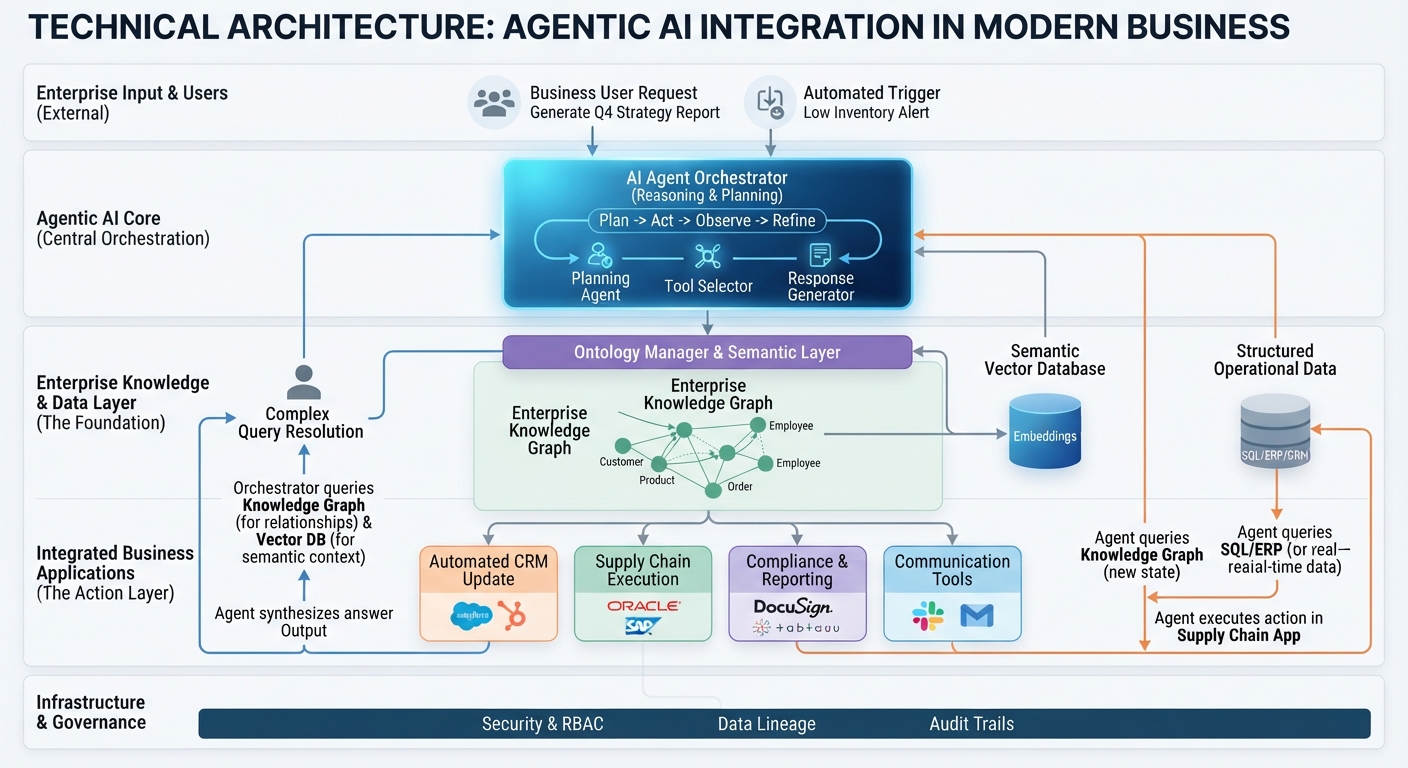
The FDE’s implementation process involves interdisciplinary skills:
- Embedding themselves into the customer’s operations to clearly understand both obvious and latent processes.
- Understanding how each of those components relates to and impacts the total organizational context.
- Solutioning massive data aggregation systems across existing SaaS and legacy data silos for a complete picture of enterprise operations.
- Cost-benefit analysis of each process to provide demonstrable targets of net cost savings and productivity gains.
- Determining which reusable primitives in their platform offering are appropriate and cost-efficient with low maintenance and rapid adaptivity.
- Prototyping various iterations of process improvements that serve the people who own those processes and can try them out.
- Achieving the buy-in of all stakeholders from the process operators to the C-suite so that the transition is successful.
- Rolling out the full implementation in a reasonably efficient timeframe that is measurable and justifies recurring revenue with minimal costs.
If that sounds a lot like a SaaS implementation specialist, you’d be right. It is like SaaS, but using an entirely new set of technologies with tight margins and far more complex tooling involving agentic workflows, customized telemetry, retrieval-augmented generation (RAG), vast company-wide data aggregation into unified knowledge graphs from many possible sources for the purposes of agentic context and highly advanced governance, compliance, security, identity, and data privacy management appropriate for enterprise use cases — including the most secure, isolated compute tenant management for highly sensitive workflows in finance and health care. FDEs are often required to service on-premises infrastructure deployments in the most sensitive sectors.
As an owner operator or executive, are you going to trust an unknown outsider to handle that, leave it to your existing IT teams to improvise and roll their own, or will you partner with the best solutions provider with the existing systems and specific experience on these types of problems?
This insanely complex set of requirements will be perfected by leading companies over the next decade to generate significant revenue and deliver real productivity gains. Engineers are not being replaced; they are being elevated up the value chain.
The challenge, of course, is that capital outlays must execute this massive, perfectly choreographed enterprise revenue expansion quickly enough to service debt obligations and satisfy the whims of an overstretched stock market through probable market oscillations.
The top five hyperscalers are driving annual capital expenditures past $600 billion, with AI infrastructure consuming roughly 75% of that total. To fund this expansion alongside multi-trillion-dollar off-balance-sheet commitments, major technology firms have leaned heavily on debt markets, issuing hundreds of billions in corporate bonds that rival national borrowing scales. Financial analysts are not stupid. A recent conservative evaluation by Richard Coffin at The Plain Bagel estimates that despite the off-balance sheet obligations, most of the major hyperscalers like Google, Meta and Microsoft are operating well within the normal range of existing data center businesses. In other words, this would be normal for data providers and is only perceived as abnormal because those businesses were previously asset-light.
Surveys of the global agentic automation market indicate that the total addressable market (TAM), valued at roughly $6 billion to $19 billion, is projected to surge rapidly over the next decade at compound annual growth rates exceeding twenty to forty percent. Analysts emphasize that specialized technical professionals, particularly forward-deployed engineers, are driving this expansion by embedding directly within organizations to customize, integrate, and scale autonomous artificial intelligence workflows. Rather than relying on off-the-shelf software, companies are heavily investing in these human-led implementation services to bridge the gap between complex enterprise systems and autonomous agents, unlocking multi-billion-dollar productivity gains across global industries.
The automation market represents only a tiny fraction—roughly 1% to 3%—of the massive capital outlays flowing into underlying AI infrastructure.
The stakes are extraordinarily high, and there’s a non-trivial probability of shortfall. Nonetheless, automation will unfold over the next ten to twenty years in fits and starts, proving as transformative as any technological shift in history.